
- Published on
TikTok Live Confidence Dropping? Signal vs. Noise (2026 Reality Check)
- Authors

- Name
- Robin
The "Good Week" Hangover
You just had your best week ever on TikTok Live. Viewers were chatting, gifts were flying, and you felt like you finally "made it."
Then, Monday hits.
Views drop by 80%. Chat is silent. You stream for 2 hours to 5 people.
The immediate feeling is visceral: "I lost it. I did something wrong. The algorithm hates me."
This is the "Confidence Drop," and it kills more streaming careers than bad equipment ever could. In 2026, TikTok's algorithm is more volatile than ever, but that volatility is often noise, not a signal.
If you react to noise like it's a signal, you will break your channel.
Diagnostic: Panic vs. Process
When the numbers drop, your brain wants to fix it now. You start changing your lighting, your game, your schedule, your personality.
Stop.
Most drops are not about you. They are about the ecosystem (holidays, server updates, big events) or just random variance.
Here is the difference between a Panic response (which destroys growth) and a Process response (which survives it):
 Figure 1: Panic leads to "fixing" things that aren't broken. Process leads to stability.
If you change your entire content strategy because of 3 bad days, you are resetting your algorithmic learning phase. You are teaching TikTok that you are inconsistent.
Signal vs. Noise: How to Tell the Difference
Before you panic, classify the drop.
It is likely NOISE if:
- It has lasted less than 7 days.
- Your retention rate (avg watch time) is stable, but reach is low.
- It coincides with a major holiday or TikTok app update.
- You physically feel tired or "off" (viewers can smell burnout).
Action: Do nothing. Keep streaming. Wait it out.
It is likely a SIGNAL if:
- It has lasted more than 14-21 days.
- Your retention rate has plummeted (people click in and leave immediately).
- You have 0 new followers for 2 weeks straight.
- You have persistent technical issues (lag, pixelation).
Action: Audit your content. Check your hook. Fix your tech.
The 30-Day Rule
Humans are bad at statistics. We judge our self-worth based on the last 24 hours.
The 30-Day Rule states: Never judge your channel's health on a timeframe shorter than 30 days.
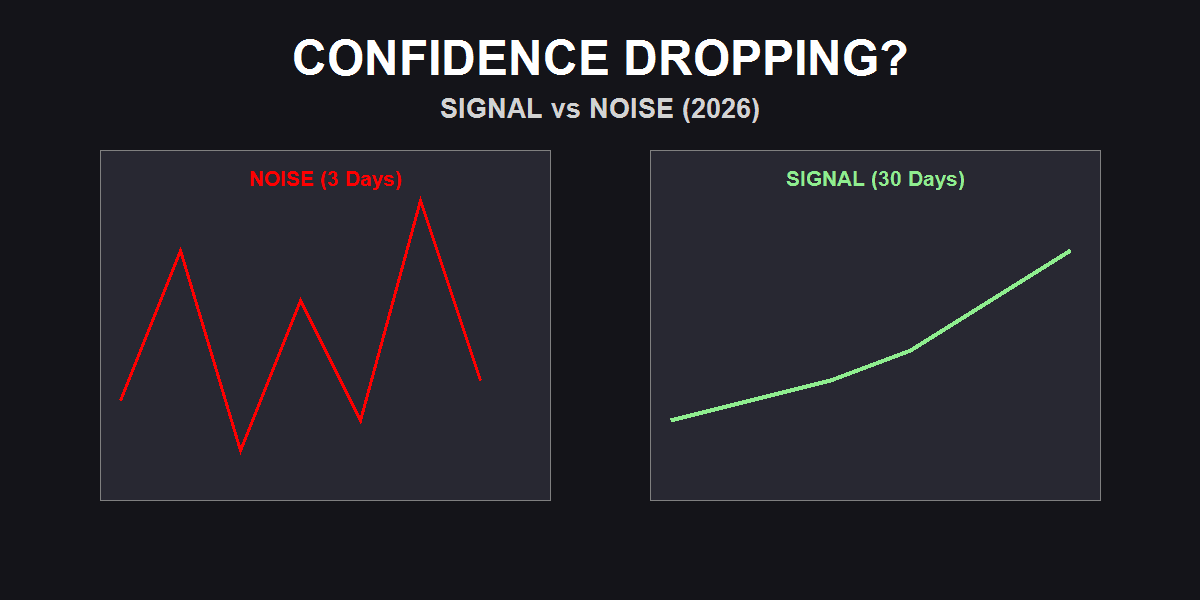
 Figure 2: One bad week looks like a disaster. A month reveals the trend.
In the visualization above, the red days feel terrible in the moment. But when you zoom out to the month view, they are just statistical noise in an otherwise healthy or average month.
Action Plan: Surviving the Dip
- The 7-Day Freeze: If views drop, change NOTHING for 7 days. Stream the same hours, same game, same energy.
- Tech Audit: verify your upload speed and OBS settings. Sometimes a "shadowban" is just a pixelated stream that nobody wants to watch.
- Review Hooks: Watch your own VODs. Are the first 3 seconds boring? That's a signal.
- Touch Grass: If you are angry at the camera, viewers will leave. Take a 2-day break. The algorithm will not punish you as much as burnout will.
FAQ
Q: Am I shadowbanned? A: Probably not. Shadowbans are rare and usually result in 0 views, not low views. You are likely just in a competitive time slot or a normal variance dip.
Q: Should I delete my low-view VODs/clips? A: No. Deleting content signals instability. Leave them up.
Q: My confidence is shot, how do I stream? A: Turn off the viewer count. Hide the numbers. Stream for the content, not the counter.
Conclusion
Confidence is a resource. Protect it.
If you let a random algorithmic fluctuation destroy your confidence, you lose. If you treat it as noise and keep shipping, you win. The creators who succeed in 2026 are not the ones with the best luck; they are the ones with the best emotional durability.