Logo
Published on

Should You Quit TikTok Live? The 2026 Decision Guide for Burned-Out Streamers

Authors
  • avatar
    Name
    Robin
    Twitter
TikTok Live Burnout Decision: Quit, Pause, or Pivot?

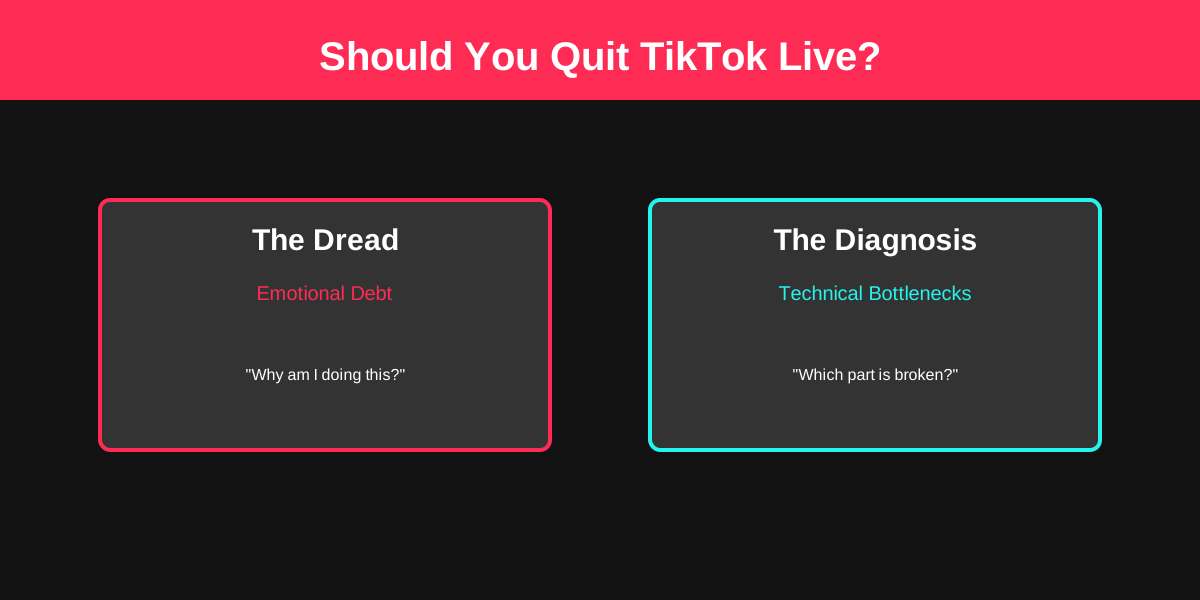
Streaming is as much about energy management as it is about data. When you feel like you 'can't go on,' it's usually either a technical bottleneck or mental burnout. This guide helps you detach from the emotion and make a rational career choice.

TL;DR

Core Pain

Severe frustration and thoughts of quitting caused by low earnings and volatile traffic.

Search Intent

Diagnosing stream bottlenecks and evaluating whether to quit TikTok Live or change niches.

Key Conclusion

Distinguish between traffic bottlenecks (fixable) and mental bottlenecks (needs rest). Use a 14-day observation period for data-driven decisions rather than emotional exits.

The most painful part of TikTok Live isn't the low numbers—it's the emotional whiplash:

  • One week you get a surge of viewers and feel like you've finally made it.
  • The next week you're back to 3-10 viewers in a dead room, thinking: "Why am I even doing this?"

In communities like r/TikTokCreators, posts titled "I'm ready to quit" usually get three types of responses:

  • "Don't blame TikTok; your stream packaging is just weak."
  • "TikTok Live is a slot machine; move to another platform."
  • "You're just burned out; take a break before making a permanent decision."

Depending on your situation, all three could be right. This guide is a decision framework designed to stop the internal spiral and help you choose a rational path.

Decision Guide: Quit vs. Pause vs. Pivot

Step 1: Define Your Real Pain (Native Phrases → Search Intent)

Creators rarely say, "My conversion funnel is weak." They usually say:

  • "I went live, but it felt pointless."
  • "I'm talking to a brick wall for hours."
  • "People are watching, but no one is following."
  • "I'm tired of begging for taps on the screen."

These are different problems. If you label them all as "TikTok is bad," you'll try random fixes and stay stuck.

Step 2: Identify Your Bottleneck (Pick One)

Find the first symptom that matches your current reality.

Bottleneck A: Distribution (TikTok isn't testing your content)

Signs:

  • You never get a "wave" of traffic after going live.
  • Your viewer count is a flat line throughout the stream.
  • "Total Viewers" is extremely low, not just the chat activity.

Community Debate:

  • View 1: "Your account is shadowbanned/restricted."
  • View 2: "Your stream looks identical to everyone else's."
  • View 3 (Dissent): "It's pure luck; don't overthink it, just post more videos."

Best Move: Treat it as a diagnostic checklist, not a mindset issue.

Bottleneck B: Retention (People join fast, leave faster)

Signs:

  • "Total Viewers" is high, but "Peak Concurrents" is low.
  • Average watch time feels like it's only a few seconds.
  • People are constantly joining, but no one stays.

The Community Usually Says:

  • "Your layout is unreadable on mobile."
  • "You take too long to get to the point."
  • "Your audio is bad, or you're silent for too long."

Best Move: Optimize your first 15 seconds (the "hook") and your on-screen visual promise.

Bottleneck C: Conversion (Viewers watch, but don't follow)

Signs:

  • You have 20-100 viewers, but almost zero new followers.
  • Viewers lurk and then leave without any interaction.
  • Your fans aren't following you to other platforms.

Typical Contention Points:

  • "Don't beg for follows; it looks desperate."
  • "You have to ask, or they won't remember."
  • "Your Call to Action (CTA) doesn't give a specific reason."

Best Move: Give a concrete, immediate reason to follow.

Bottleneck D: Energy (You hate streaming)

Signs:

  • You dread going live even if numbers are good.
  • You feel anger when viewers don't talk.
  • You feel empty rather than peaceful after ending a stream.

This is the most overlooked point for creators. If you are in "Energy Debt," no amount of settings optimization will solve the problem.

Best Move: Before quitting permanently, pause streaming, reduce frequency, or try a pivot.

The One Diagram That Makes the Decision Easier

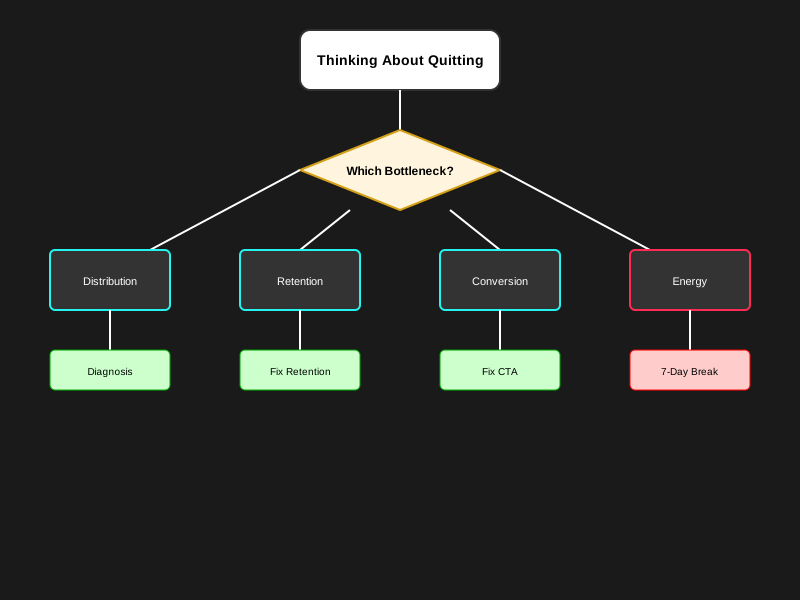
Quit vs Pivot vs Pause Decision Framework

Quit vs Pivot vs Pause Decision Framework: Diagnose your energy state and technical bottlenecks to make the most rational choice.

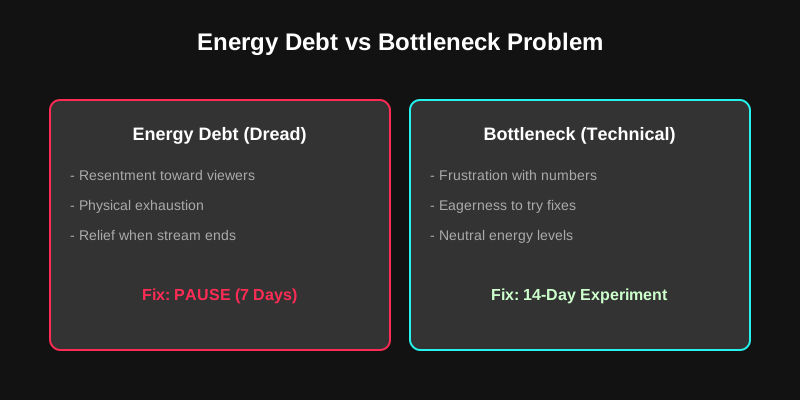
Energy Debt vs Technical Bottleneck Comparison

Energy Debt vs Technical Bottleneck Comparison: Distinguish between problems that can be fixed with settings and those that require rest.

This diagram illustrates a mistake most creators make: choosing to "quit" when facing a technical bottleneck that could be fixed. The key branching point is "Energy." If you hate the process, you don't need more discipline—you need a new plan.

14-Day Experiments (Pick one and commit)

This is the rule: one experiment, one bottleneck, 14 days. No mixing.

Experiment 1: Distribution Reset (for “no traffic”)

  • Stream shorter (45–90 minutes), high-energy
  • Title + overlay that states the goal in one sentence
  • Start talking immediately (no “starting soon” screen)
  • Post a short clip the same day that matches the stream promise

Experiment 2: Retention Upgrade (for “joins but leaves”)

  • Make your screen readable in vertical: large face cam or large gameplay, not tiny
  • Put the goal on screen (rank, challenge, consequence)
  • Repeat the context every 2–3 minutes like you’re talking to a new room

Experiment 3: Conversion Rebuild (for “watch but don’t follow”)

  • Replace “follow please” with a reason
    • “Follow to see the next attempt in 10 minutes.”
    • “Follow if you want the build and settings, I’ll pin it next stream.”
  • Move one action off-platform with a clear reward (Discord loadout, schedule, VODs)

Experiment 4: Energy Debt Payoff (for “I hate this”)

  • Pause for 7 days (no lives)
  • Write down what you hate: hours, game, chat pressure, metrics, mods, tech
  • Restart with a smaller container:
    • 3 days a week
    • 60 minutes per session
    • one repeatable “event” format

Actionable Checklist (Decide Like a Pro)

  • Write your raw pain phrase in one sentence
  • Pick one bottleneck (distribution, retention, conversion, energy)
  • Choose the matching 14-day experiment
  • Track only two metrics for the experiment (not everything)
  • Decide after 14 days: continue, pivot, pause, or quit

FAQ

Is it normal to want to quit TikTok Live?

Yes. TikTok Live is volatile: it can reward you fast and then feel silent for no clear reason. The decision becomes easier when you isolate the bottleneck instead of interpreting every bad stream as a personal failure.

How do I know if I’m burned out or just impatient?

If you feel dread before you go live, and relief when you stop, that’s closer to burnout than impatience. If you feel neutral before streams and frustrated only after bad numbers, it’s often a bottleneck problem you can fix.

Should I switch to Twitch or YouTube Live?

Switching helps if your biggest pain is volatility and weak loyalty. But if your bottleneck is retention or conversion, you’ll likely carry that problem with you. Fix the bottleneck, then choose the platform.

What if my streams get views but zero chat?

That’s common on TikTok. Many viewers are in passive mode. Treat chat as a conversion, not a default. Use low-friction prompts (yes/no, 1/2, A/B) tied to the gameplay decision happening right now.

Practical Conclusion

Quitting can be the right move. But “I’m done” is a feeling, not a strategy. If you’re considering quitting TikTok Live, decide based on your bottleneck:

  • Fix distribution, retention, or conversion with a 14-day experiment.
  • Treat energy debt as a separate problem and pause first.

Then choose: continue, pivot, or leave. Not because you’re broken—because your plan is.